

Have you ever wondered why you feel better after getting “popped?” Do you sometimes twist your back after sitting for a long time, feel a pop and feel a bit less stiff and sore?
Let’s dive in to the current research on why getting a manipulation – also known as a “pop – is beneficial.
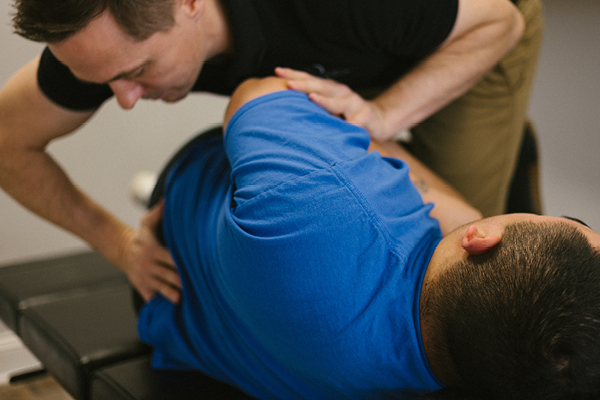
A manipulation is a technique performed by a specially trained physiotherapist that is defined as a high velocity, low amplitude, minimal force thrust. The goal of this treatment is to reduce pain in the neck or back.
There are many different thoughts and ideas when it comes to the effects and efficacy of a manipulation. These include biomechanical, neurophysiological and psychological mechanisms. Let’s take a more in depth look at the three different proposed mechanisms.
First – biomechanical. The biomechanical effects are based on the joint being hypomobile. Essentially, there is a decrease or restriction in a movement, making it stiff and sore. The loss of joint mobility can be caused by a joint capsule or ligament adhesions, entrapment of a disc fragment, hypertonicity of the deep intrinsic muscles, joint fixation, or mechanical irritation of the nervous system.
A manipulation may help to restore the joint mobility, reduce stiffness and improve physiological range of motion. Most studies show these improvements are short term and not long term. So it is important to complete the exercises your physiotherapist prescribes you for homework to maintain these improvements.
Second – neurophysiological. The neurophysiological effects are based on the complex interactions of both the peripheral and central nervous system. These systems work together to encompass the pain experience. A manipulation may result in a reduction in pain through inhibition of nociceptors of the spinal cord. Essentially, the pain signals are blocked. It may also improve chemical alterations and change the central nervous system thresholds. This reduces the intensity of the pain.
A manipulation can cause hypoalgesia. This term means there is a diminished sensitivity to pain. It can also change your blood flow, heart rate, skin conductance and skin temperature. As well, it can cause a decrease in muscle hypertonicity and decrease in inflammation.
Third – psychological. The psychological effects are based on the various placebo, patient expectation and psychosocial factors. Research shows a manipulation can also cause a small improvement in your mood. Studies have shown patients reported having higher satisfaction after a manipulation.