


Golf might not look like a physically demanding sport at first glance, but anyone who has played regularly—or treated golfers in a sports medicine setting—knows that a consistent, powerful swing requires a highly coordinated blend of mobility, stability, strength, and control.
Whether your patients are weekend golfers, competitive amateurs, or older adults trying to stay active, understanding the physical demands of the golf swing can help guide both performance enhancement and injury prevention.
Below are the five most important physical demands of the golf swing—and why they matter.
The Foundations of a Powerful and Efficient Golf Swing
1. Thoracic Spine Mobility
If there’s one area that consistently limits golfers, it’s the thoracic spine.
Why it matters
The golf swing is fundamentally a rotational movement. During the backswing, the golfer needs to rotate their upper body over a relatively stable lower body. This rotation primarily comes from the thoracic spine—not the lumbar spine.
Adequate thoracic rotation allows for:
- A full backswing
- Greater separation between hips and shoulders
- Increased clubhead speed
What happens when it’s limited
When thoracic mobility is restricted, golfers tend to compensate by:
- Over-rotating through the lumbar spine
- Early lifting of the arms, leading to poor club face control
- Swaying instead of rotating, leading to poor sequencing
These compensations not only reduce performance but significantly increase the risk of low back pain, one of the most common injuries in golfers.
Clinical takeaway
Improving thoracic rotation can often produce immediate gains in swing efficiency and reduce stress on the lumbar spine. It’s one of the highest yield areas to assess and treat for golfers of all levels.
Try these!
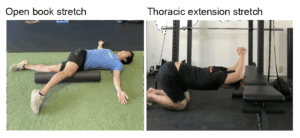
2. Hip Mobility (Especially Internal Rotation)
The hips are the engine of the golf swing.
Why it matters
During both the backswing and downswing, the hips need to rotate efficiently to generate and transfer force.
Each hip plays a slightly different role:
- Lead hip (front hip): requires internal rotation during the downswing
- Trail hip (back hip): requires internal rotation during the backswing
This rotation allows for proper weight transfer and sequencing of the swing.
What happens when it’s limited
- Early extension (standing up out of posture)
- Reduced power generation, leading to distance being left on the table
- Increased strain on the knees and lower back
In particular, limited lead hip internal rotation is strongly associated with compensatory lumbar rotation and extension, increasing injury risk.
Clinical takeaway
Assessing and restoring hip internal rotation is critical, especially in patients with low back or hip pain. Even small improvements here can dramatically clean up swing mechanics.
Try these!
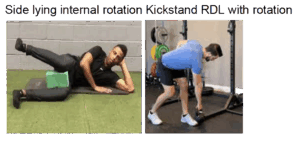
3. Lumbopelvic Stability (Core Control)
Mobility gets a lot of attention, but without stability, it’s useless.
Why it matters
The golf swing requires a stable base to transfer energy from the ground, through the hips and trunk, and into the club. The lumbopelvic region acts as the central link in the kinetic chain.
Key roles of core stability include:
- Maintaining posture throughout the swing
- Controlling rotational forces in opposing directions
- Preventing excessive spinal movement
What happens when it’s lacking
- Loss of posture during the swing
- Inconsistent ball striking
- Over reliance on arms rather than trunk rotation
It also increases the likelihood of overuse injuries in the lumbar spine due to poor load distribution.
Clinical takeaway
Core training for golfers should focus on anti-rotation, dynamic control, and endurance rather than isolated strength.
Try these!
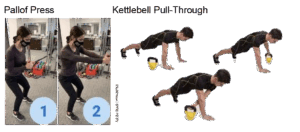
4. Lower Body Strength and Ground Reaction Force
Power in the golf swing doesn’t come from the arms, it comes from the ground.
Why it matters
Efficient golfers use the ground to generate force, transferring energy upward through the body in a coordinated sequence.
- Pushing into the ground during the downswing
- Rotational force through the hips
- Proper weight shift from trail to lead leg
Stronger lower body musculature allows for:
- Greater force production
- Improved balance and control
- Increased clubhead speed
What happens when it’s lacking
- Overuse of upper body musculature
- Reduced power and distance
- Poor weight transfer and sequencing
This often leads to fatigue-related swing breakdowns and compensatory injuries.
Clinical takeaway
Strengthening the glutes, quadriceps, and posterior chain is essential for both performance and injury prevention.
Try these!
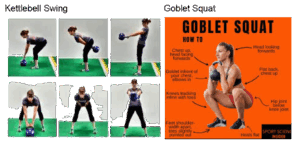
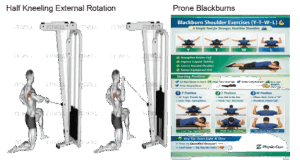
5. Shoulder Mobility and Scapular Control
The shoulders connect the body to the club, so they need to move well and be well controlled.
Why it matters
During the golf swing, the shoulders must move through large ranges of motion while maintaining control of the club.
- Adequate shoulder external and internal rotation
- Proper scapular positioning and control
- Coordination between arms and trunk
Efficient shoulder mechanics help:
- Maintain swing plane
- Optimize clubface control
- Reduce strain on the elbow and wrist
What happens when it’s limited
- “Over-the-top” swing patterns
- Inconsistent ball contact
- Increased stress on elbow/wrist
It may also contribute to rotator cuff and elbow injuries.
Clinical takeaway
Scapular stability and coordination are just as important as shoulder mobility for performance and durability.
Try these!
Bringing It All Together: The Kinetic Chain
The golf swing is a full-body, integrated movement. Limitations in one area will affect others:
- Poor hip mobility → increased lumbar rotation → low back pain
- Weak core control → poor force transfer → overuse of shoulders
- Limited thoracic rotation → compensatory arm lift → inconsistent ball striking
This is why a comprehensive physiotherapy assessment is so valuable for golfers.
Practical Implications for Patients
For golfers presenting in clinic, consider:
- Screening thoracic and hip rotation early
- Assessing movement patterns, not just isolated joints
- Incorporating golf-specific strength and control exercises
- Educating patients on how physical limitations affect their swing
Even recreational golfers can benefit significantly from small improvements in mobility and control.